Dioramas

moose diorama

The diorama —a distinctive fusion of art and science— has provided a window onto wilderness for generations of museum visitors. For many, dioramas provided their only opportunity to experience distant places and exotic wildlife. Impressive in scale and detail, and frequently capturing a dramatic moment, these displays were early versions of virtual reality. Although their magic has diminished somewhat with the advent of television and the internet, dioramas still provide an opportunity to experience these magnificent animals up close.

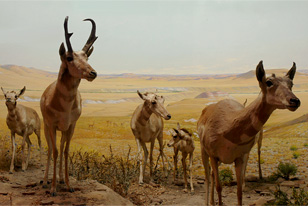
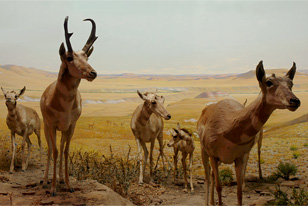
There are 37 dioramas in the Academy, the majority of which were created in the 1920s and 1930s. Dioramas featuring bison, musk-ox, bears, mountain sheep and moose can be found on the main floor in North American Hall. African animals such as lion, zebra, opaki, gorilla and antelope, and Asian animals, including tiger, kiang, panda and yak are located in African and Asian Halls on the second floor. Several bird dioramas are located on the third floor.

Creating the Dioramas

kiang diorama

Dioramas were elaborate productions involving adventurers, scientists, artists and artisans. Ambitious and often arduous expeditions were formed to obtain the animals and record information about their habitats. These efforts often took months to complete and involved scores of people. In some cases, particularly with the Dolan expeditions to Central Asia during the 1930s, these efforts also provided the primary source of scientific knowledge about these remote corners of the globe. For instance, most of what was known until recent decades about the Great Panda, Takin and Wild Yak came from the Academy Expeditions.

Each diorama typically has three parts. At the heart are the large animals such as a moose, tiger or buffalo. Contrary to popular perception, these animals are not stuffed. Instead, they're mounted on an armature made up of the original skeleton covered by a sculpted body of wire and plaster. The skin of the animal was then stretched over this armature to form the animals you see.

The next part of the diorama is the elaborately detailed foreground. In most cases, the small animal tucked away in a corner of the display were collected at the same time and place as the larger animals. The plants and rocks are usually artificial, but they were based on samples collected during the expeditions. In all cases, the foreground elements were meticulously created by highly-skilled artisans.

The final part of the diorama is its background. These exquisite paintings formed a backdrop that conveyed a both a sense of space and place. In the most successful dioramas, the three parts combine to create a remarkable three-dimensional illusion.

A Snapshot of Time and Place

giant sable

Each diorama represents a snapshot of a time and place. Far too often, that place is no longer wild nor the animals plentiful. Today, most museum visitors won't approve of the killing of animals required for the creation of these displays. But the dioramas played a major role in the celebration of Americans in their natural heritage and increased their awareness and appreciation of the loss of wilderness. The rise of the Conservation Movement and the popularity of dioramas went hand-in-hand. It's an effort that must continue.

Become a North American Explorer!

pdf download of North American Journey

Download North American Journey (.pdf, 1.8MB), an activity guide for children four to ten years of age. This fun-filled guide explores the plants, animals and habitats of the North American Hall dioramas.

(Complementary copies of North American Journey are also available at the Admissions Desk in the Museum.)

top of page